Oral-B iO Series 3 Vs Oral-B iO Series 7
Side by side on motion, gums, braces, pressure sensor, battery, heads, app and three-year cost. The short answer comes first.
Our call: for most people, the Oral-B iO Series 3. Pick the Oral-B iO Series 7 instead if this is you: Gum Care plus a color screen, if you will not go all the way to Series 9.
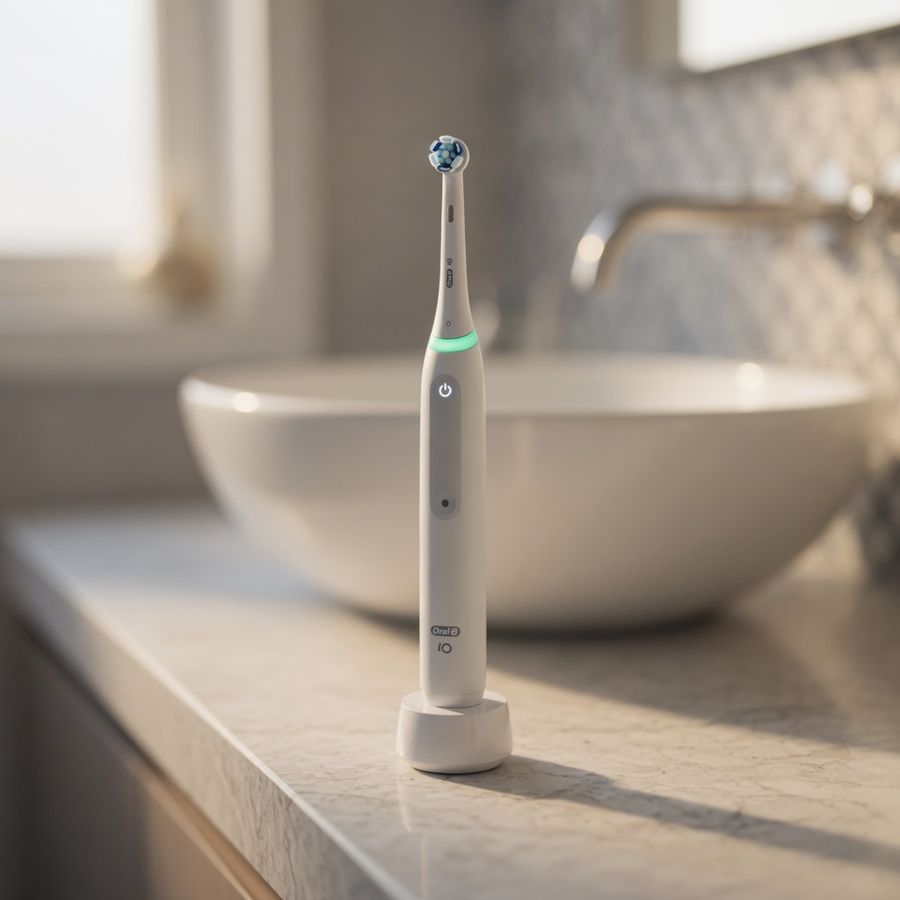
Oral-B iO Series 3
About $90 · ranked #1 of 17
Our pick in this pair
- Oscillating-rotatingMotion
- 14 daysBattery
- YesPressure sensor
- $186Three-year cost
Best for: most people who want a real pressure sensor without paying for an app.
Check today's Oral-B iO Series 3 price →
Oral-B iO Series 7
About $220 · ranked #11 of 17
The alternative
- Oscillating-rotatingMotion
- 14 daysBattery
- YesPressure sensor
- $316Three-year cost
Best for: Gum Care plus a color screen, if you will not go all the way to Series 9.
Check today's Oral-B iO Series 7 price →Price buttons are Amazon affiliate links. A commission does not change which brush wins this page. Disclosure.
Where Do They Differ?
| Where they differ | Oral-B iO Series 3 | Oral-B iO Series 7 |
|---|---|---|
| Street price | $90lower | $220 |
| Modes | 3 | 5 |
| App | No | Oral-B app |
| Travel case | No | Yes |
| Three-year cost | $186lower | $316 |
Only the lines where the two brushes differ. A tinted cell is the plain better number on that line: cheaper, longer, or the feature is there.
Jump to a question
- How Do They Clean
- Which Is Better For Sensitive Gums
- Which Is Better With Braces
- Which Stops You Brushing Too Hard
- Which Battery Lasts Longer
- Do The Replacement Heads Cross Over
- Which Has An App, Timer Or Screen
- Which Costs Less Over Three Years
- Are They ADA Seal Accepted
- Which One Should You Buy
- Full spec sheet
They share a motion family, so most of this page is about features and the bill. Specs are researched from manufacturer pages and named 2026 reviews. Where a number was not published, the cell says n/a. Nothing here is a personal bench log. The method is on how we compare.
How Do They Clean?
Both are oscillating-rotating brushes, so the feel is close. The differences are in features and the bill.
Oscillating-rotating, Oral-B does not publish a strokes-per-minute figure for iO the way it does for the older 3D line. Magnetic iO drive: oscillating-rotating round head plus micro-vibrations
Oscillating-rotating, Oral-B does not publish a strokes-per-minute figure for iO. Magnetic iO drive with a color display and Gum Care.
A round oscillating head is a tooth-by-tooth scrub. A sonic head is a sweep, and the fluid it throws is part of the clean. A jet or a water flosser is a third job. Do not score those as if they were the same machine.
Which Is Better For Sensitive Gums?
Neither has a clear edge here. Compare the gentle modes below.
Sensitive mode plus a visible pressure ring. No Super Sensitive mode on the Series 3.
Sensitive mode, but no Super Sensitive on the Series 6 and 7.
Dentists who talk about recession in public usually point at a sonic brush before a round oscillating one, because the sweep feels less sharp on exposed roots. That is a feel call, not a license to skip the pressure sensor. If a brush has no sensor, technique is the whole safety system.
Which Is Better With Braces?
Neither has a braces advantage on paper. Read each note below.
Round head reaches around brackets better than a long sonic head for many people. Confirm the head your orthodontist wants.
Round head, app map, color display.
Round heads reach the tooth face around a bracket more easily for a lot of people. Long sonic heads cover more enamel per second and bump the wire more often. A built-in flosser helps the gumline under the wire, which a brush alone does not. None of these replace the conversation with your orthodontist. Ask before you aim a jet at hardware.
Which Stops You Brushing Too Hard?
Both warn you when you press too hard. How they warn you is the difference.
Visible 360-degree ring: green just right, red too hard and the brush slows, white too soft
3-color 360-degree ring
A hidden sensor that only cuts the pulsations is easy to miss. A light ring you can see in a mirror is the one people actually change behavior for. Adaptive systems that turn the motor down are a step past a warning. No sensor at all means the brush will happily let you scrub a groove into the gum.
Which Battery Lasts Longer?
Neither has a verified battery advantage.
14 days. About 2 weeks at two 2-minute sessions a day. Oral-B lists a longer window on some bundles. Lithium-ion, magnetic charger.
14 days. About 2 weeks. Magnetic charger, about 3 hours. Display shows charge.
Runtime assumes two minutes, twice a day, on a gentler mode. Whitening modes, radios, and jets spend it faster. A NiMH pack that wants an overnight charge is a different product from a lithium handle that is full before dinner.
Do The Replacement Heads Cross Over?
Yes. Both take iO heads, so a drawer of refills survives the swap.
Round, cups one tooth. iO heads only. Not compatible with Pro, Smart, or Genius heads. About $8 a head. Genuine iO heads run about $8 to $10 each, often $30 to $40 for a 4-pack before sales. Replace about every 3 months.
Round iO head only. About $8 a head. iO refill pricing. The handle premium does not buy cheaper heads.
The American Dental Association tells people to change a brush about every three months, or sooner if the bristles splay. Four heads a year is the math we use. A subscription only helps if you were going to buy that brand's head anyway.
Which Has An App, Timer Or Screen?
Only the Oral-B iO Series 7 has an app.
App: no app. Timer: 2-minute timer and 30-second quadrant pacer. Handle screen: no.
App: the Oral-B app. Timer: 2-minute timer, pacer, on-handle display. Handle screen: yes.
Apps coach coverage. They do not clean teeth. If you will not put a phone on the sink, a brush that needs the phone for its headline feature is the wrong spend. A timer and a quadrant pacer are the features that change a two-minute session. Quadpacer is Philips's name for that 30-second buzz. Oral-B does the same job without the trademark.
Which Costs Less Over Three Years?
The Oral-B iO Series 3 costs less over three years: $186 against $316.
Handle $90 plus about $32 a year in heads: $186 over three years. Warranty 2 years.
Handle $220 plus about $32 a year in heads: $316 over three years. Warranty 2 years.
Street handle prices here are typical US prices as of October 2026, not a live checkout. A subscription that unlocks a warranty is a cost, not a gift. Read the cancel terms before you count the years.
Are They ADA Seal Accepted?
Both carry a verified ADA Seal.
Accepted, per the manufacturer or a current product page.
Accepted, per the manufacturer or a current product page.
The Seal means the American Dental Association accepted a safety and efficacy file for that product. It is not a ranking, and a missing seal is not a verdict that the brush fails. Some brands never file. Neither brush is a treatment for gum disease. Bleeding that continues after a week of gentle brushing is a dentist appointment, not a mode setting.
Which One Should You Buy?
For most people in this pair, buy the Oral-B iO Series 3. Buy the Oral-B iO Series 7 if this sounds like you: Gum Care plus a color screen, if you will not go all the way to Series 9.
Choose it for: most people who want a real pressure sensor without paying for an app.
Choose it for: Gum Care plus a color screen, if you will not go all the way to Series 9.
Editorial rank on this site puts the Oral-B iO Series 3 ahead. That rank is a buying call. It is not a claim that the other brush cleans worse in a lab we did not run.
What Goes Wrong With Each?
- iO heads cost more than classic Oral-B CrossAction heads and will not fit a Pro handle you already own
- No Bluetooth, so there is no coverage map if that is the feature you came for
- Battery is shorter than the iO Series 2, which Oral-B rates up to 4 weeks
- No Super Sensitive mode. Series 5 and Series 8 have it. Series 7 does not.
- A large price jump over Series 5 for a screen and one mode
- Still no floss, no camera, no jet
Full Spec Sheet
| Spec | Oral-B iO Series 3 | Oral-B iO Series 7 |
|---|---|---|
| Street price | $90 | $220 |
| Motion | Oscillating-rotating | Oscillating-rotating |
| Movements | Oral-B does not publish a strokes-per-minute figure for iO the way it does for the older 3D line | Oral-B does not publish a strokes-per-minute figure for iO |
| Modes | 3 | 5 |
| Mode list | Daily Clean, Sensitive, Whitening | Daily Clean, Sensitive, Whitening, Gum Care, Intense Clean |
| Pressure sensor | Visible 360-degree ring: green just right, red too hard and the brush slows, white too soft | 3-color 360-degree ring |
| Timer | 2-minute timer and 30-second quadrant pacer | 2-minute timer, pacer, on-handle display |
| App | No | Oral-B app |
| Handle display | No | Yes |
| Battery | 14 days | 14 days |
| Charge time | 3 hr | 3 hr |
| Waterproofing | IPX7 class. Oral-B rates iO handles for shower use. | Shower-safe handle. |
| Travel case | No | Yes |
| Noise | Quieter than older Oral-B oscillating handles. Still a mechanical buzz, not a Sonicare hum. | iO buzz. |
| ADA Seal verified | Yes | Yes |
| Head price, about | $8 | $8 |
| Heads, year-one estimate | $32 | $32 |
| 3-year cash | $186 | $316 |
| Handle weight | 140 g | n/a |
| Warranty | 2 yr | 2 yr |
| Built-in floss or jet | No | No |
| Camera | No | No |
| Subscription heads | No | No |
| Best for | Most people who want a real pressure sensor without paying for an app | Gum Care plus a color screen, if you will not go all the way to Series 9 |
How Do These Two Sit In The Wider Rankings?
Sitewide, the brush we point at first is the Oral-B iO Series 3, with the Philips Sonicare 4100 next to it. This pair is one cell in that table. See the best picks by need if you have not picked a motion yet, or open the Brush Finder if budget and gums are the whole question.
External reading that matches a claim on this page: the ADA toothbrush overview for the three-month head swap and the Seal, Oral-B's iO guide for series features, and Dyson's CameraJet page for the 2026 jet brush. A brand page is a spec source, not a referee.
Short Answers
What is the difference between the Oral-B iO Series 3 and the Oral-B iO Series 7?
Both are oscillating-rotating brushes, so the feel is close. The differences are in features and the bill. Oral-B iO Series 3: Oscillating-rotating, Oral-B does not publish a strokes-per-minute figure for iO the way it does for the older 3D line. Magnetic iO drive: oscillating-rotating round head plus micro-vibrations Oral-B iO Series 7: Oscillating-rotating, Oral-B does not publish a strokes-per-minute figure for iO. Magnetic iO drive with a color display and Gum Care. A round oscillating head is a tooth-by-tooth scrub. A sonic head is a sweep, and the fluid it throws is part of the clean. A jet or a water flosser is a third job. Do not score those as if they were the same machine.
Which is better for sensitive teeth, the Oral-B iO Series 3 or the Oral-B iO Series 7?
Neither has a clear edge here. Compare the gentle modes below. Oral-B iO Series 3: Sensitive mode plus a visible pressure ring. No Super Sensitive mode on the Series 3. Oral-B iO Series 7: Sensitive mode, but no Super Sensitive on the Series 6 and 7. Dentists who talk about recession in public usually point at a sonic brush before a round oscillating one, because the sweep feels less sharp on exposed roots. That is a feel call, not a license to skip the pressure sensor. If a brush has no sensor, technique is the whole safety system.
Which is better with braces, the Oral-B iO Series 3 or the Oral-B iO Series 7?
Neither has a braces advantage on paper. Read each note below. Oral-B iO Series 3: Round head reaches around brackets better than a long sonic head for many people. Confirm the head your orthodontist wants. Oral-B iO Series 7: Round head, app map, color display. Round heads reach the tooth face around a bracket more easily for a lot of people. Long sonic heads cover more enamel per second and bump the wire more often. A built-in flosser helps the gumline under the wire, which a brush alone does not. None of these replace the conversation with your orthodontist. Ask before you aim a jet at hardware.
Do the Oral-B iO Series 3 and the Oral-B iO Series 7 stop you brushing too hard?
Both warn you when you press too hard. How they warn you is the difference. Oral-B iO Series 3: Visible 360-degree ring: green just right, red too hard and the brush slows, white too soft Oral-B iO Series 7: 3-color 360-degree ring A hidden sensor that only cuts the pulsations is easy to miss. A light ring you can see in a mirror is the one people actually change behavior for. Adaptive systems that turn the motor down are a step past a warning. No sensor at all means the brush will happily let you scrub a groove into the gum.
How long do the Oral-B iO Series 3 and Oral-B iO Series 7 batteries last?
Neither has a verified battery advantage. Oral-B iO Series 3: 14 days. About 2 weeks at two 2-minute sessions a day. Oral-B lists a longer window on some bundles. Lithium-ion, magnetic charger. Oral-B iO Series 7: 14 days. About 2 weeks. Magnetic charger, about 3 hours. Display shows charge. Runtime assumes two minutes, twice a day, on a gentler mode. Whitening modes, radios, and jets spend it faster. A NiMH pack that wants an overnight charge is a different product from a lithium handle that is full before dinner.
Will replacement heads from one fit the other?
Yes. Both take iO heads, so a drawer of refills survives the swap. Oral-B iO Series 3: Round, cups one tooth. iO heads only. Not compatible with Pro, Smart, or Genius heads. About $8 a head. Genuine iO heads run about $8 to $10 each, often $30 to $40 for a 4-pack before sales. Replace about every 3 months. Oral-B iO Series 7: Round iO head only. About $8 a head. iO refill pricing. The handle premium does not buy cheaper heads. The American Dental Association tells people to change a brush about every three months, or sooner if the bristles splay. Four heads a year is the math we use. A subscription only helps if you were going to buy that brand's head anyway.